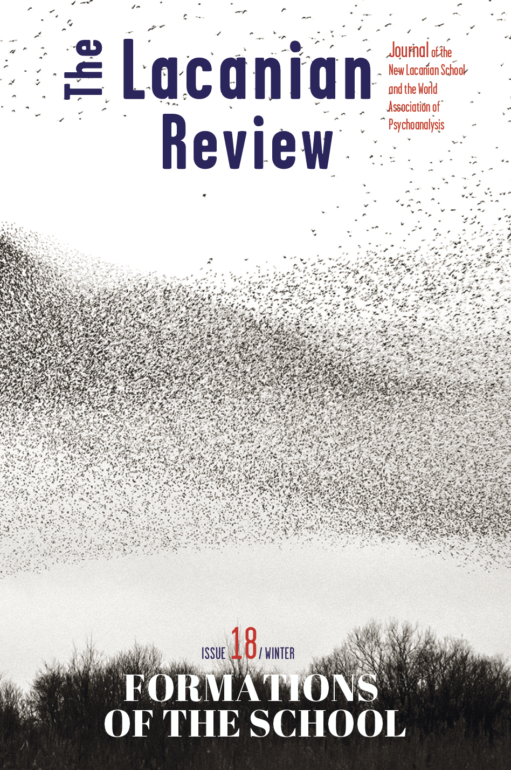
Description
The Lacanian ReviewAbonnement avec réduction de -10% à -80%Votre période d’abonnement, 1 an (2 numéros) ou 2 ans (4 numéros), commence avec le prochain numéro de TLR. Le premier numéro que vous recevrez après avoir commandé un abonnement est le prochain numéro à paraître. Tout abonnement souscrit après jusqu’au 15 Mars 2026 débutera par le TLR n°18.
|
The Lacanian ReviewSubscribe now and save up to 80%.Your subscription period, 1 year (2 issues) or 2 years (4 issues), begins with the forthcoming issue of TLR. The first issue you will receive after ordering a subscription is the next issue to be released. Any subscription purchased before March 15, 2026 will start with TLR #18.
|
About The Lacanian Review
The Lacanian Review is a semiannual print and digital journal published in English. TLR offers newly established texts by Jacques Lacan, Jacques-Alain Miller, and prominent international figures of the Lacanian Orientation.
This series features testimonies of the pass, new theoretical developments in Lacanian psychoanalysis, dialogues with other discourses, and articles on contemporary culture, politics, art and science.
Each issue explores a theme intersecting the symptoms of our era and emerging work in the New Lacanian School (NLS) and the World Association of Psychoanalysis (WAP).
The Lacanian Review #18
FORMATIONS OF THE SCHOOL
Cristina Rose Moro
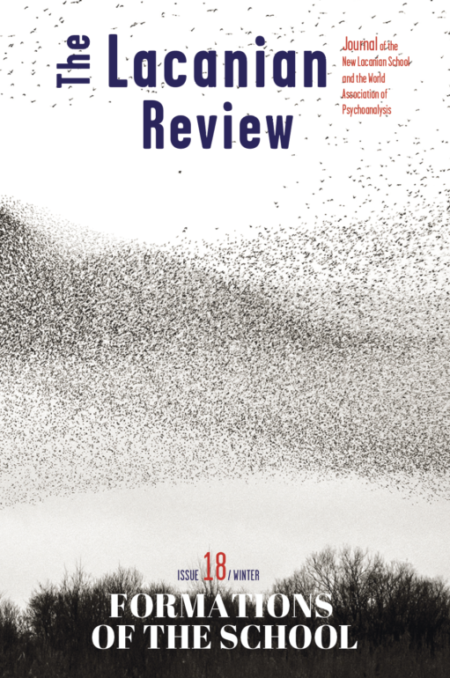
From a distance, it appears as one: a single figure crossing the sky. Approach, and it breaks apart—into innumerable bodies, tiny birds, each veering, each adjusting, yet together composing a living whole. This is a murmuration: a flock of starlings, the paradox of the one and the many in motion. Its name is already an echo of the wings that compose it.
In this issue of The Lacanian Review, we ask: what is the School, and what are its formations? Like a murmuration, the School is not a unit but a choreography of singular ones. It implies movement without orchestration, orientation without command. What cannot be collectivized nonetheless holds together. An emergent form, with individual trajectories intersecting and diverging. The School takes shape only in motion, shaping—and being shaped by—those who pass through it.
In his “Founding Act,” Jacques Lacan declared himself “as alone as I have always been in relation to the psychoanalytic cause,” and yet among the “dedicated workers” of the School. Alone, but not without others. Jacques-Alain Miller gives this paradox its edge: “The Analyst of the School is not an animal without transference […]. He binds himself to [the School]. In this way, the analytic cause is an indissoluble bond.” Work-transference—the transference to the School that animates work—is this bond.
Our School is not a psychoanalytic institution among others. It does not consolidate itself through training programs, curricula, statutes, or ideals of belonging. It exists through formations—plural, contingent, often discontinuous—that emerge from the psychoanalytic experience itself. Lacan founded a School not to shelter psychoanalysis from the world, but to expose it to what, in psychoanalysis, resists closure: the real at stake in formation, in transmission, and in each clinical case.
The title of this issue, Formations of the School, echoes Freud’s formations of the unconscious. A formation is not planned; it erupts. The analytic discourse produces them. Slips, dreams, witticisms, symptoms—these formations bear witness to a knowledge that insists without being mastered. Our School, insofar as it is Lacanian, is itself such a formation. It is not an ideal to be realized but an effect of discourse, sustained—each time—by the desire of the analyst. It changes shape. It does not settle.
Articulated across languages and countries, our School is composed of what Lacan called “scattered, ill-assorted individuals,” bound together not by identifications, but by work: work-transference. What forms the School are the dispositifs Lacan invented—or reworked—in response to precise questions: How can psychoanalysis be transmitted without hardening into dogma? How does one authorize oneself as an analyst? What is an analyst? This last question marks a hole at the center of the School—one preserved as such. The School has no image. Its topology depends on preserving that hole, empty of any pregiven or definitive answer.
Supervision, the pass, and cartels are not administrative tools. They are operators that put the desire of the analyst to the test. They put us to work.
Supervision is often imagined as a scene of correction or education: knowledge descending from the one-who-knows to the one-who-lacks. Lacanian supervision undoes this fantasy. It is super-audition: a space where something is heard otherwise, where the analyst confronts the limits of their act, and where the real of the case that resists sense is preserved. Supervision forms not by reassurance, but by disturbance. It loosens imaginary mastery and reorients the analyst toward not-knowing and toward the real. For Lacan, an analyst is not one who knows, but one who has been transformed by their own analysis such that the desire of the analyst becomes operative. A mutation at the level of being, Miller says.
The pass is the School’s most radical formation. It formalizes a daring proposition: that something of the end of analysis can be said—and transmitted—without abolishing the real that resists transmission. A singular saying that also matters for the collective. The pass does not certify; it exposes. It asks whether you have traversed the fantasy sufficiently for the object a to finally fall—to cease organizing your desire in the same old ways—and whether the analyst who emerges can sustain the act without leaning on the guarantee of the Other.
The cartel is a response to the inertia of identification. It is designed to provoke work rather than cohesion, new knowledge rather than consensus. When a cartel functions, something singular is extracted from a sustained encounter with a hole in one’s knowledge. The School is built from these points of elaboration—partial, transmissible, even groundbreaking.
What, then, is formed in the School? Not analysts as finished identities, but a desire—the desire of the analyst—always in formation, from which one can respond to the real encountered in clinical practice and beyond. The School does not promise harmony. It exposes it as a semblant. It stages encounters and missed encounters through which something of Lacanian psychoanalysis, today, takes shape.
At a time when institutions increasingly demand transparency, metrics, and immediate results, our Lacanian School insists on another temporality. Formation takes time. It proceeds via cuts and detours, divisions, resonances, after-effects. The School endures not by adapting psychoanalysis to the demands of the present, but by holding open a space in which its discourse may continue to produce effects—sometimes disruptive ones.
The texts gathered in this issue bear witness to the vitality of these formations. They show a School at work, confronting its own conditions of existence today. We invite you to read them not as statements of doctrine, but as traces—marks left by a living practice. If the School is a formation, it is one that must be continuously re-formed and reinvented—by each analyst, in each new era, and in each act.
The Lacanian Review #18
FORMATIONS OF THE SCHOOL
CONTENTS
Editorial
Cristina Rose Moro, Formations of the School
From Supervision to Super-Audition
Patricia Bosquin-Caroz, In Supervision
Dossia Avdelidi, Supervision Awakens
Juana Cavaliere Silva, Supervision and its Effects
Lieve Billiet, A Desire for Supervision
Frank Rollier, Authorizing Oneself to Go for Supervision
Markus Zöchmeister-Bénard, On the Function of Supervision/Contrôle
Dominique Holvoet, The Challenge of Supervision After the Pass
Thomas Rhatelot, The Necessity of Supervision
Christiane Alberti, How to Curb the Desire for Contrôle?
Cartels
Pascale Fari, The Cartel’s Secret Theaters
Gil Caroz, Provoking the Crisis
Joanne Conway, The Cartel and the Desire of the School
The Pass
Carolina Koretsky, A Painful Separation
Neus Carbonell, SUQUETDEPEIX
Anna Aromí, ¡Ale!
Hélène Bonnaud, From Traversal of Fantasy to Iteration
What is the School ?
Jacques-Alain Miller—L’École, le Transfert et le Travail
Jacques-Alain Miller—The School, the Transference, and Work
Sarah Birgani, The School as a Blank Page
Panagiotis Kosmopoulos, The School of Portable Bodies
Leticia Lopez, An Unprecedented Mode of Work
Hamutal Shapira, Leave, Live
Duane Rousselle, History: A Question of Testimony
Patricia Bosquin-Caroz, Traversing the Fantasy and Resolving the Transference
Schools of Animals
Éric Zuliani, Do Speaking Beings Form Societies?
Neil Theise, Organization and the Edge of Chaos